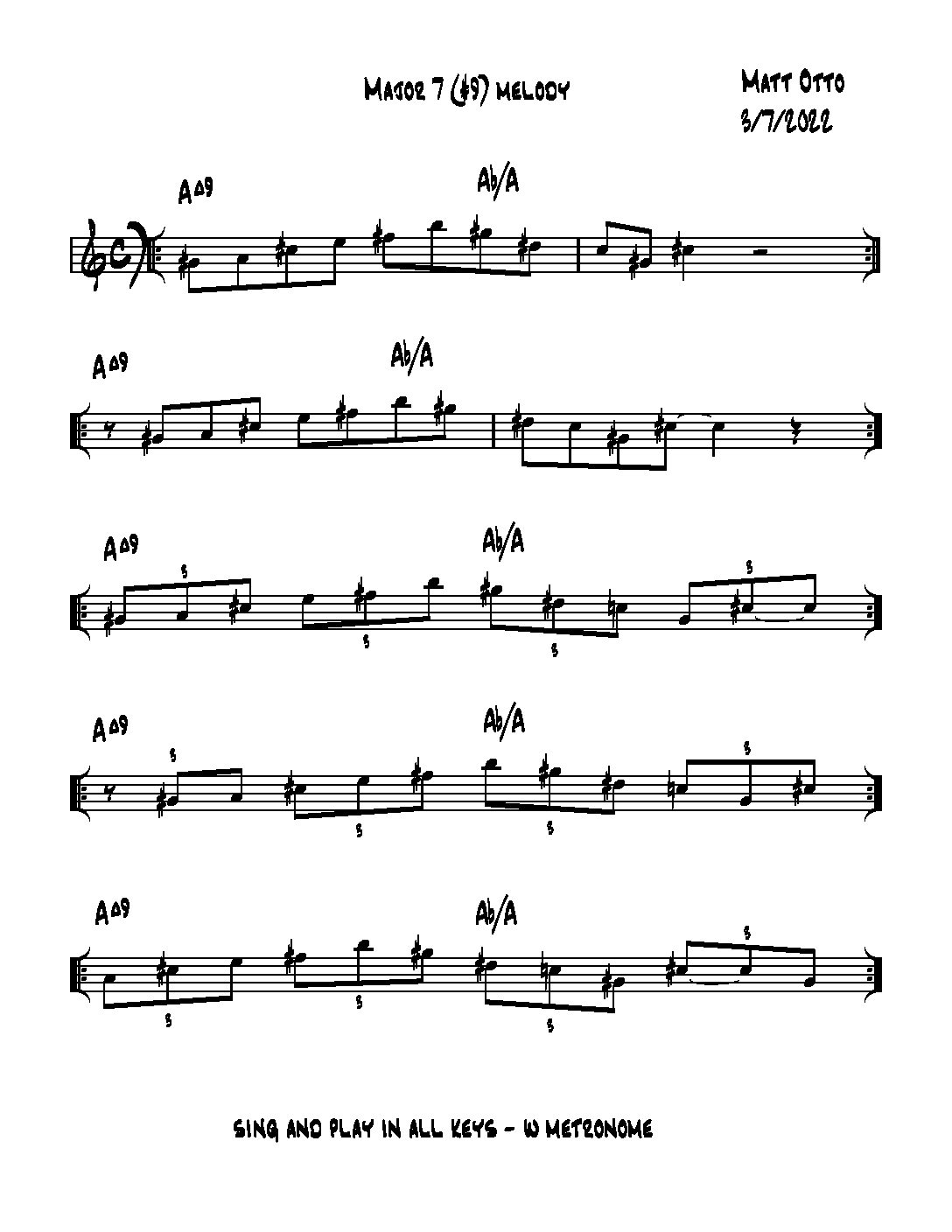
In this lesson we look at a short melody derived from the classical augmented scale ( 1, b3, 3, 5, b6, 7, 1 ) and play it in triplets grouped in 7. The melody could work in several harmonic contexts but we’ll just look at it in the context of concert A major 7 (#9 b13). Many improvisers use this scale in it’s various modes to improvise over major, minor and dominant chords.
The melody is played in a symmetrical sequence ascending by minor 6ths yet all the notes are contained in one scale. This scale, like the diminished scale or the whole tone scale is symmetrical and so 1 scale applies to 3 keys each a major 3rd apart (tri-tonic). Therefore there are a total of 4 scales each one representing 3 keys. You can think of the scale as compared to the major scale ( 1, b3, 3, 5, b6, 7, 1 ) or as two augmented triads one half step apart i.e. A+ and G#+ creating the scale covering the keys of A, C# and F. This is the same scale used in Lesson 7 where the major 7 #5 chords found in the scale are used within a dominant 7 context. Also, Lesson 56, on Giant Steps uses this scale in the first 8 bars over the tri-tonic progression.
In the video we’ll fist practice the rhythm of the triplets grouped in 7 over 2 bars of 4/4 time with the metronome – just singing. Than we’ll play the melody slowly rubato over a drone, next with the drone and the metronome and lastly with a bass and drums play along track at 120 bpm. If you’re interested in the drum and bass backing track, it is available here at CD Baby for 99 cents.
After you’re comfortable with the melody try improvising from the scale and perhaps find the different triads and 7th chords found in the scale. You could also play the melody starting on the 1st, 2nd or 3rd triplet of beat 1, 2, 3, or 4 in order to help hear the phrase in a different location in the harmonic rhythm.
Sometimes working on just one key for a while can be beneficial. Today I practiced a bit on concert A major - on tenor sax this is B major, which does not lay well on the horn for me, mainly due to my deficiency using the side A# fingering. Also, it’s more difficult for me to visualize the 7 modes in this key than compared to concert Bb major.
After singing and playing over an A drone for a while, I came up with a simple melody that moves down through the 7 modes of concert A major by diatonic step (all over an A drone). For rhythmic interest, each melody is played first as all dotted quarter notes (a 3 over 4 grouping) and than in 8th notes. I started by singing the exercise until it was easy to hear and visualize and than put it on the horn.
There’s a PDF with the melody for C, Bb and Eb below.
This is a simple melody that uses the 2nd mode of harmonic major over a -7b5 chord (or half diminished) in one key (concert F#-7b5) which is concert E harmonic major, the 2nd mode being concert F#-7b5(nat9, nat13).
This 2nd mode of harmonic major creates an interesting “bright” sound over half diminished; natural 9 and natural 13.
The more common locrian mode of the major scale gives you a b9 and b13 on a -7b5 and the popular 6 mode of melodic minor will give you a natural 9 and a b13 over a -7b5.
The 2nd mode of harmonic minor over -7b5 will give you the b9 and the natural 13.
All 4 scales will work nicely over a half diminished chord but this melody just focuses on using the natural 9 and natural 13 sound (2nd mode of harmonic major).
Here’s a simple chart that should help make it clear:
F#-7b5 (b9,b13) = F# locian (G maj scale 7th mode) F#, G, A, B, C, D, E, F#
F#-7b5(nat9,b13) = 6 mode of A melodic min F#, G#, A, B, C, D, E, F#
F#-7b5(b9, nat13) = 2nd mode of E harmonic min F#, G, A, B, C, D#, E, F#
F#-7b5(nat9,nat13) = 2nd mode of E harmonic maj F#, G#, A, B, C, D#, E, F#
The intro and outro clips in the video are short improvisations using this 2nd mode of harmonic major i.e. concert E harmonic major, 2nd mode = F#-7b5(nat9, nat13).
The short melody in the lesson uses a grouping of 7/8 over 4/4 and is a sequential melody descending by diatonic 3rds through the mode (cycle 6 in Mick Goodrick’s system).
Try singing the melody over a drone or the F#-7b5 chord until it feels comfortable than play idea on your instrument. After try improvising freely with the mode.
For more an introduction on the use of the 7 modes of harmonic major, you can pick up my book on the topic here.
This ii-7, V7, I melody that uses minor triads with an added 9th (or 2nd) i.e. 1,3,5,9 or 1,9,3,5 etc…
The first part of the melody uses a minor triad with the added 9 over the ii chord (D-7 would use a d minor triad with the 9th “E” added). The second part of the melody uses the minor triad with an added 9th one half step above the root (G7 would use an Ab minor triad with the 9th “Bb” added) or a tritone away from the first triad. This triad with added 9 over the dominant produces an “altered” sound giving you b9, #9, 3 and #5 on the dominant and comes from the 7 mode of melodic minor or altered scale). The line resolves to the 5th of the I chord… Try singing the line slowly at the piano to learn to hear it well before playing it on your primary instrument.
My friend Miles mentioned to me that Stefon Harris refers these triads with any single added note as “quadrads”. A quadrad can basically be thought of as a 4 note scale.
Once you’ve worked on this simple melody through the keys try improvising using the 4 note “quadrads” over the same ii – V – I progression. Last, try to use the quadrads over a standard or original you enjoy improvising on. This should help the new sound eventually become part of what you hear.
This is a simple minor major nine melody I started hearing in my head a few days ago. It’s nothing special but I enjoyed singing it and working it slowly through the keys. Sometimes it’s the simplest ideas that help me connect with my ear and get me out of my “thinking mind” while playing. Often when I’m practicing something like this, since the content has been determined ahead of time, I can focus on other elements of the improvisational process such as sound, breath, feel, staying relaxed, posture, and listening.
This melody comes from the ascending melodic minor scale.
There’s a PDF of the melody and an mp3 midi play along as well.
John Stowell, a wonderful guitar player from Portland Oregon came out to Kansas City and we played a clinic, gig and session together. Here’s a few tunes that I recorded using my little mp3 recorder.
Some of my students and many professional musicians and hobbyists that I know, experience a lot of stress, anxiety and general nervousness prior to, and during music performance.
This short post will examine a few strategies that I have used over the years to help me work with stage fright and performance anxiety. Sometimes, when you least expect it, you get nervous, while other times you feel like your hanging out with good friends in a relaxed environment – eventually you can be comfortable with either.
Things to think about:
1. Be prepared musically. This is the most important issue – practice the material, memorise it if appropriate, work on it until you can play it correctly over and over with very little effort. If you suffer badly from stage fright than include rehearsing the stage banter you will use during the performance; write it out, memorise it, and practice performing it. These two things will not ensure you will play perfectly, but they will increase your odds tremendously if and when your attention becomes taxed or divided. Being nervous is fine as long as it does not keep you from playing well and enjoying the experience.
2. Practice feeling nervous. I learned this simple trick from a great book on playing under stressful conditions, “Performance Success” by Don Greene. Basically, seconds before you work on something you will perform, get your heart rate way up by doing a long set of fast jumping jacks, berpees, jump squats or mountain climbers , then immediately play the piece or improvisation on your instrument. This does a great job emulating the effects of adrenalin (the fight or flight bio-chemical that makes us feel so nervous). This exercise will help you get used to the feeling of “nerves” and help you learn to focus extra energy into awareness and concentration instead of fear. You will begin to realise that even when your heart is racing, you can still play and improvise well and that the increased heart rate might actually elevate your technique and emotional content. After doing this many times, the effects of adrenaline will feel less unusual and much more like a normal state of performance.
3. Research stage fright and performance anxiety. Here are some of the books I have read and recommend, “Performance Success“, by Don Greene, “Stage Fright” by Kato Havas, ” The Inner Game of Muisc” by Barry Green, “On Piano Playing” by Abby Whiteside, “Effortless Mastery” by Kenny Werner, “Zen Mind Beginners Mind” by D.T. Suzuki. All these books and countless others can give you the gems of wisdom that will slowly, over time, begin to eliminate your fear and performance anxiety. Eventually you recognise the nerves as good energy that will help to heighten your awareness and concentration.
4. Deep Breath. Slow, deep breathing will clam you and even out your energy and focus. One simple way is to breath deep, tense up all your muscles and hold them as tight as possible for about 10 seconds than let go and start to breath in and out to a slow count of 10 – about 10 seconds in and 10 seconds out. While breathing and counting, relax and observe muscle tension. Doing this up until the first note of performance will go along way towards creating a calm, focused state of mind and body.
5. Shift your focus from yourself to those around you. While preparing to play, focus on others; the audience, friends, family, the rest of the musicians performing with you. While actually playing, listen to the other musicians more than yourself, be aware of the audience, look at them, make some eye contact. .. it may be difficult and uncomfortable at first but practice it each time you perform and you’ll get better at it – more comfortable and more relaxed. If you can maintain slow deep breathing while doing this, all the better.
6. Take on an open (non defensive) posture. Deliberately keep your arms open (not crossed), your back straight, your chin up, your legs open (not crossed), in other words, take on open postures. Open postures will help tell your mind and body that “all is well” and that there is no danger, nothing to fear. Over time, this will help you accept the nervous energy as a “positive” experience and as completely “normal”. Your posture may feel forced but if you stick with it, over time, it will become natural. Copying the postures of performers you admire can be a short cut to finding a higher comfort level on stage.
7. Take a class on public speaking or acting. A inexpensive class at a community college can be more challenging and helpful towards overcoming performance anxiety than playing an instrument on stage. If you take a few classed on public speaking, or acting, playing music will become much easier and your comfort on stage will increase immensely. There is also the option of joining an inexpensive speech club like Toast Masters.
I’ve also found some useful information in the videos below. Just watching through them in the days leading up to an important gig can help you prepare for a relaxing performance.
In this lesson we’ll look at the first ii – V7 – I melody found in the “Modern Jazz Vocabulary vol. 2” book. This melody is comprised of major 1st inversion triads descending by half steps and a few chromatic passing tones at the end. The melody is also grouped in 6 against the harmonic rhythm in 4/4. The descending triads end up outlining some nice tensions over the the ii – V7 – I progression. Although this is a melodic sequence it is still loosely based and George Garzone’s Triadic Approach which I recommend checking out. In the video I play this short melodic phrase through the 12 keys at both a med and med up tempo. Remember to work on this and all the material from the blog from memory as much as possible. I believe it’s better to learn the idea from memory in one key than to read it in 12 keys.
Modern Jazz Vocabulary Vol. 2 Is an in depth study of classic II-V-I progression found commonly in jazz improvisation. The nearly 300 melodic examples incorporate rhythmic groupings, triad pairs, enclosures, chromatics, synthetic scales, chord substitutions and more.
“…I can definitely use this book for myself and my students.”
In lesson 63 we look at a simple melody that uses both the natural 9 (the #11) and the b9 on a dominant 7th chord. Within the first bar of this melody a major triad a whole step above the root is present. Somtimes this is refered to as an upper structure triad since it outlines some of the notes above the root, 3rd, 5th and 7th of the chord (in this case the 13th, the 9th, and the #11th).
The resolution melody in bar 2 does not contain a 3rd or a 7th so you could conceivably play this idea over a major, minor or dominant 7th chord. It can be interesting to improvise over a chord using just the root, 5th, 9th and 13th – creating a nice open sound (you can hear this concept used by many great improvisers such as Art Tatum, Monk, and Dexter Gordon).
There is a play along mp3 below to help you hear the harmonic context of the melody and also a “sing along” mp3 with the melody for ear training, singers, or those suffering from RSI or carpal tunnel syndrome. In the video I first play the resolution melody (5, 13, 9, 13, 5, 9) in the second bar of the play along through the keys. Next I play just the V7 melody resolving just to the 5th of the resolution chord through the keys and lastly I play the whole melody through the keys.
I had the honor of doing a masterclass at Casa Valdez Studios while in Portland earlier this month. We talked a lot about singing over droneswhile visualizing the related fingerings on your instrument. Using this method to learn to hear vertical harmony, and horizontal melody can really help one begin to connect with their ear and inner voice and help free them from playing by rote, i.e. using mainly muscle memory habits, chord scale theory and/or other forms of analysis to improvise.
David cooking Vegan Sausage.
Getting to teach the class and play for a week with David Valdez and some amazing Portland musicians was a huge inspiration. Not only was the music gratifying and challenging, I ate better than I’ve eaten for years; David is both an amazing player and an amazing cook, and knows all the best restaurants in town!
David recorded the whole “lecture” and posted it on his blog, here’s the link:
We sang the root motion to some simple tunes and talked about playing what you hear (the melody you hear note by note in your mind) as opposed to playing what you “think” (using theory and concepts). We also briefly talked about some “thinking based concepts” like playing “outside” the harmony using modulation (playing inside melodies in unrelated keys), as well as a variation of Garzone’s triadic approach, and playing atonal or random intervals over structured harmony.
I’ll be posting some of the gigs that we played together during that week and hopefully you’ll be able to hear some of these concepts put into practice. Here’s short solo from one of our gigs.
Curtis Swift did the Solo Transcription – check out his site here.
~Enjoy!
The mp3s below feature John Stowell on guitar, Todd Strait on drums, Chris Higgins on bass, David Valdez on Alto sax and myself on Tenor sax and compositions.
While working on major 7th and minor 7th “drop 2″ chord voicings, I found a nice shape to work on through the keys. Drop 2 is a great way to voice chords and has been used in classical and jazz music for hundreds of years. Several of Mick Goodricks books really get into the drop 2 voicing in depth while this short exercise just looks at one simple major and minor voicing in isolation. Arpeggiating voicings on a single note instrument can be interesting and challenging and will help you incorporate intervallic melodies to contrast traditional linear ideas. One nice thing about working with a chord voicing is that, no matter what order you play the notes in, a strong melody ensues.